Move Semantics in C++
Back to Basics: Move Semantics - Andreas Fertig - CppCon 2022
Source: Back to Basics: Move Semantics - Andreas Fertig - CppCon 2022
Overloads
Before talking about move semantics, we first need to see what C++ already had.
Suppose we write these two overloads:
1
2
3
4
5
6
7
void Fun(std::vector<int>& byRef) {
    std::cout << "byRef\n";
}

void Fun(const std::vector<int>& byConstRef) {
    std::cout << "byConstRef\n";
}
And then use them like this:
1
2
3
4
5
6
7
8
void Use() {
    std::vector v{2, 3, 4};
    const std::vector cv{5, 6, 7};

    Fun(v);
    Fun(cv);
    Fun({3, 5, 6});
}
The output is:
1
2
3
byRef
byConstRef
byConstRef
So C++ does this:
Fun(v)callsFun(std::vector<int>&)Fun(cv)callsFun(const std::vector<int>&)Fun({3, 5, 6})also callsFun(const std::vector<int>&)
What is happening here?
The first two calls are expected:
vis a non-const lvalue, so it binds toT&.cvis a const lvalue, so it cannot bind toT&. It binds toconst T&instead.
The interesting case is this one:
1
Fun({3, 5, 6});
This creates a temporary std::vector<int>. That temporary is an rvalue, not an lvalue.
A non-const lvalue reference cannot bind to it, so this overload is not viable:
1
void Fun(std::vector<int>& byRef)
But a const lvalue reference can bind to a temporary, so C++ chooses:
1
void Fun(const std::vector<int>& byConstRef)
Why const T& is not enough
So far, temporaries already have a place to go: const T&.
That is safe, but it also means C++ still puts these two cases together:
- a real const object
- a temporary object
Those are not the same thing.
- A const object should not be modified.
- A temporary, on the other hand, is often about to disappear anyway.
So const T& is good enough for correctness, but it is still too restrictive.
It lets us observe a temporary, but not treat it as something we may steal resources from.
What we really want is a third overload:
1
void Fun(std::vector<int>&& byRvalueRef);
This gives temporaries their own path.
Then C++ can say:
- lvalue →
T& - const lvalue →
const T& - rvalue / temporary →
T&&
That is the key setup for move semantics.
Rvalue references and std::move
Now suppose we add one more overload:
1
2
3
4
5
6
7
8
9
10
11
void Fun(std::vector<int>& byRef) {
    std::cout << "byRef\n";
}

void Fun(const std::vector<int>& byConstRef) {
    std::cout << "byConstRef\n";
}

void Fun(std::vector<int>&& byRvalueRef) {
    std::cout << "byMoveRef\n";
}
And use the same calls again:
1
2
3
4
5
6
7
8
void Use() {
    std::vector v{2, 3, 4};
    const std::vector cv{5, 6, 7};

    Fun(v);
    Fun(cv);
    Fun({3, 5, 6});
}
Now the output becomes:
1
2
3
byRef
byConstRef
byMoveRef
So after adding T&&, the first two calls still behave the same:
vgoes toT&cvgoes toconst T&
But the temporary is different now.
1
Fun({3, 5, 6});
This temporary is an rvalue, so C++ now prefers the new overload:
1
void Fun(std::vector<int>&& byRvalueRef)
This && parameter is an rvalue reference. So now temporaries no longer fall back to const T&. They get their own overload.
Before, C++ could only say:
- this is a mutable lvalue
- this is either a const lvalue or a temporary
Now it can say one more thing:
- this is an rvalue, so use the rvalue overload
That is exactly what move semantics needs.
Once temporaries have their own overload, functions and types can treat them differently. Instead of only observing them through const T&, they can use the move path.
Triggering the rvalue overload
So far, the rvalue overload is only picked for temporaries:
1
Fun({3, 5, 6});
But a named object is still an lvalue:
1
2
3
4
void Use() {
    std::vector v{2, 3, 4};
    Fun(v);
}
So this still calls:
1
void Fun(std::vector<int>& byRef)
not the rvalue overload.
If we want to trigger the rvalue overload for v, we can cast it:
1
2
3
4
void Use() {
    std::vector v{2, 3, 4};
    Fun(static_cast<std::vector<int>&&>(v));
}
So overload resolution now picks:
1
void Fun(std::vector<int>&& byRvalueRef)
Writing that cast directly is ugly, so we normally use std::move:
1
2
3
4
5
6
#include <utility>

void UseMove() {
    std::vector v{2, 3, 4};
    Fun(std::move(v));
}
std::move does not move anything by itself. It only casts its argument to an expression that can bind to T&&.
So before std::move, v is an lvalue and goes to T&. After std::move(v), the expression becomes an rvalue and can go to T&&.
std::movedoes not move. It only enables the move path.
Some notes about std::move
At this point, there are a few important things to keep in mind:
std::moveis only a cast.- Temporary objects already use the move path by default.
- We use
std::moveonly when we have a named object and want to treat it as an rvalue. - Move semantics is just an additional overload that is allowed to steal resources from the source object.
std::movedoes not perform the move itself. It only makes moving possible.
Value categories
To understand move semantics better, we now need a slightly more precise vocabulary.
At the highest level, expressions are split into:
- lvalue
- rvalue
But in modern C++, rvalue is further split into:
- xvalue
- prvalue
So the full picture is:
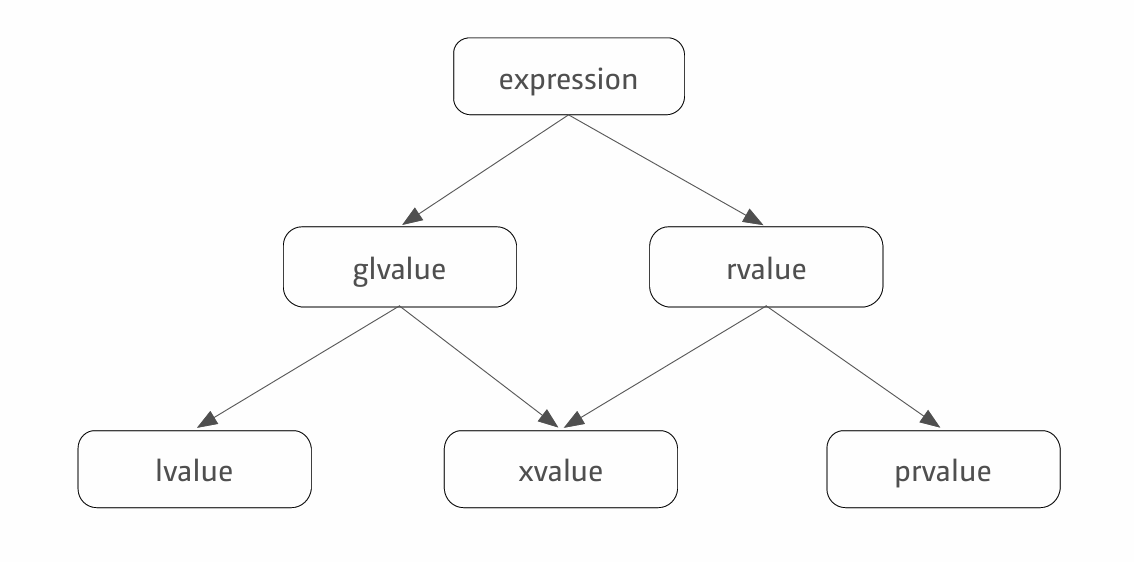
That sounds annoying at first, but for move semantics we only need a few simple examples.
1
2
3
4
5
6
Object base{};
Object obj2 = base;
Object obj3 = GetValue();        // suppose GetValue() returns Object&&
Object obj4 = std::move(base);
Object obj5 = GetOtherValue();   // suppose GetOtherValue() returns Object
Object obj6 = 5;
Here:
baseis an lvalueGetValue()is an xvaluestd::move(base)is an xvalueGetOtherValue()is a prvalue5is also a prvalue
The main intuition
An lvalue is something with identity that we usually treat as a persistent object.
A prvalue is a pure temporary value.
An xvalue is also an expiring value, but unlike a prvalue, it usually refers to an existing object that we are allowed to move from.
That is why std::move(base) is an xvalue, not a prvalue. base still exists. We are just saying it may now be treated as an expiring object.
What matters for move semantics
For this topic, the most important points are:
- named objects like
baseare usually lvalues std::move(x)produces an xvalue- temporaries like
5are usually prvalues - both xvalues and prvalues are rvalues
So when people say “move works on rvalues”, that includes both:
- prvalues
- xvalues
That is why both a temporary object and std::move(obj) can trigger the move path.
Why move can be faster
Now we can see where move semantics actually helps.
Suppose a string stores its characters in heap memory:
1
2
3
4
5
6
7
8
9
10
11
12
13
14
15
class string {
    size_t mLen{};
    std::unique_ptr<char[]> mData{};

public:
    string(const char* data);               // constructor

    string(const string& rhs);              // copy constructor
    string& operator=(const string& rhs);   // copy assignment

    string(string&& rhs);                   // move constructor
    string& operator=(string&& rhs);        // move assignment

    char* c_str() const { return mData.get(); }
};
For the copy operations, we must allocate new memory and duplicate the characters:
1
2
3
4
5
6
7
8
9
10
11
12
13
14
15
// copy constructor
string::string(const string& rhs)
: mLen{rhs.mLen}, mData{std::make_unique<char[]>(rhs.mLen)} {
    std::copy_n(rhs.mData.get(), mLen, mData.get());
}

// copy assignment
string& string::operator=(const string& rhs) {
    if (&rhs != this) {
        mLen = rhs.mLen;
        mData = std::make_unique<char[]>(mLen);
        std::copy_n(rhs.mData.get(), mLen, mData.get());
    }
    return *this;
}
That is the expensive path.
The move operations are different:
1
2
3
4
5
6
7
8
9
10
11
12
13
// move constructor
string::string(string&& rhs)
: mLen{std::exchange(rhs.mLen, 0)}, mData{std::exchange(rhs.mData, nullptr)}
{}

// move assignment
string& string::operator=(string&& rhs) {
    if (&rhs != this) {
        mLen = std::exchange(rhs.mLen, mLen);
        mData = std::exchange(rhs.mData, std::move(mData));
    }
    return *this;
}
Here we do not allocate new memory and do not copy the characters. We just transfer ownership of the existing buffer from rhs to *this.
That is where the performance win comes from.
So the key difference is:
- copy constructor / copy assignment: allocate and duplicate the resource
- move constructor / move assignment: transfer the resource
For resource-owning types, move can be much cheaper than copy because it avoids the expensive part.
Moved-from objects
Consider this code:
1
2
3
string src{"Hello"};
string other{std::move(src)};
std::cout << src.c_str();
After the move, src is a moved-from object.
That does not mean src is destroyed. It also does not mean src is invalid.
A moved-from object is still valid, but its value is generally unknown.
C++ move is usually non-destructive. That means the source object still exists after the move, but we should not assume much about its state.
In practice, a moved-from object must at least be:
- destroyable
- assignable
Anything more than that depends on the type.
Never rely on the value of a moved-from object.
If we want to use it again, we should first put it back into a known state, usually by assigning a new value to it.
For example:
1
2
3
4
5
string src{"Hello"};
string other{std::move(src)};

src = string{"World"};
std::cout << src.c_str();
This is fine, because after the assignment, src is back in a valid and known state.
Why noexcept matters
Move support alone is not the full story. For the STL, noexcept also matters.
Consider this type:
1
2
3
4
5
6
7
struct Object {
    Object() { printf("ctor\n"); }
    Object(const Object&) { printf("copy ctor\n"); }
    Object& operator=(const Object&) { printf("copy assign\n"); return *this; }
    Object(Object&&) { printf("move ctor\n"); }
    Object& operator=(Object&&) { printf("move assign\n"); return *this; }
};
And then:
1
2
3
4
5
6
7
int main() {
    std::vector<Object> v{};
    v.push_back(Object{});

    printf("second element\n");
    v.push_back(Object{});
}
Output:
1
2
3
4
5
6
ctor
move ctor
second element
ctor
move ctor
copy ctor
Even though Object has move operations, std::vector may still choose copying when it needs to reallocate its elements.
Now compare that with the same type after adding noexcept:
1
2
3
4
5
6
7
struct Object {
    Object() { printf("ctor\n"); }
    Object(const Object&) { printf("copy ctor\n"); }
    Object& operator=(const Object&) { printf("copy assign\n"); return *this; }
    Object(Object&&) noexcept { printf("move ctor\n"); }
    Object& operator=(Object&&) noexcept { printf("move assign\n"); return *this; }
};
Once the move operations are marked noexcept, the move path becomes much more useful to the container.
The reason is exception safety.
When std::vector grows, it may need to relocate its existing elements into new storage. If it starts moving elements and one move throws in the middle, some old elements may already have been modified, so rolling back cleanly becomes hard.
Copying avoids that problem: if a copy throws, the original elements are still untouched in the old storage, so the vector can keep its old valid state when an exception happens.
That is why, for move-aware types, noexcept is often an important part of the design.
std::move vs std::forward
std::move is not always the right thing
Consider this function:
1
2
3
void Innocent(std::string& value) {
    std::string local = std::move(value);
}
And then:
1
2
3
4
5
6
7
void Use() {
    std::string s{"A very very very very very very loooooong "
                  "string to defeat the small string "
                  "optimization SSO; hopefully."};
    Innocent(s);
    std::cout << "'" << s << "'";
}
The output is:
1
''
So even though Innocent only takes value as an lvalue reference, it still moves from it. That is the problem.
From the caller side, s is still a normal named object. But inside the function, std::move(value) says that we may treat it as an rvalue, so the move path is used.
This is why std::move is not automatically the right thing. Using it means we may leave the source object in a moved-from state.
So the rule is simple:
- use
std::moveonly when you really no longer need that object - do not use it just because “move is faster”
Use std::forward in templates
The previous example used a normal lvalue reference parameter:
1
void Innocent(std::string& value);
But the same mistake also appears in templates. Consider this version:
1
2
3
4
template<typename T>
void Innocent(T&& value) {
    std::string local = std::move(value);
}
At first, this may look more generic and more powerful. But it still has the same problem.
If we call it with an lvalue:
1
2
3
4
5
6
7
void Use() {
    std::string s{"A very very very very very very loooooong "
                  "string to defeat the small string "
                  "optimization SSO; hopefully."};
    Innocent(s);
    std::cout << "'" << s << "'";
}
then value is actually bound to that lvalue. So using std::move(value) still forces the move path and may leave s moved-from.
The correct tool here is std::forward:
1
2
3
4
template<typename T>
void Innocent(T&& value) {
    std::string local = std::forward<T>(value);
}
Now the value category is preserved:
- if the caller passes an lvalue, it stays an lvalue
- if the caller passes an rvalue, it stays an rvalue
So in templates, std::move is usually too aggressive. std::forward is the right tool when we want to pass the argument onward without changing whether it was an lvalue or an rvalue.
Move or forward
If the type is fixed, use std::move when we want to treat the object as movable.
1
2
3
4
5
6
void Fun(Object p) {
    x = std::move(p);
}

Object o{/* ... */};
x = std::move(o);
But if the object comes from deduction, then it may represent either an lvalue or an rvalue. In that case, we should preserve the original value category with std::forward.
1
2
3
4
5
6
7
template<class T>
void Fun(T&& p) {
    x = std::forward<T>(p);
}

auto&& o{/* ... */};
x = std::forward<decltype(o)>(o);
So the rule is:
- use
std::forwardwhen the object comes from deduction and you want to preserve its value category - otherwise, use
std::movewhen you want to treat the object as movable
Perfect forwarding
Here is a more typical use of std::forward:
1
2
3
4
5
6
7
8
9
struct Apple {
    Apple(const std::string& s) { std::cout << "lvalue: " << s << '\n'; }
    Apple(std::string&& s) noexcept { std::cout << "rvalue: " << s << '\n'; }
};

template<typename T, typename U>
auto make(U&& value) {
    return T{ std::forward<U>(value) };
}
And then:
1
2
3
4
5
6
void Use() {
    std::string str{"Hello"};

    Apple x{make<Apple>(str)};
    Apple y{make<Apple>("World"s)};
}
The output is:
1
2
lvalue: Hello
rvalue: World
This works because std::forward<U>(value) preserves the original value category:
- if the caller passes an lvalue, it stays an lvalue
- if the caller passes an rvalue, it stays an rvalue
That is why this is called perfect forwarding. We pass the argument onward without accidentally turning every case into a move.
Use move only rarely
- In general, the compiler is our friend.
- Temporary objects are automatically moved.
- For return values, the compiler might apply optimizations such as copy elision. You do not beat copy elision with
std::move.
Compiler-generated special members
Move semantics is also tied to the compiler-generated special member functions.
Consider this class:
1
2
3
4
5
6
7
class Object {
    int* _data{};

public:
    Object() : _data{new int{6}} {}
    ~Object() { delete _data; }
};
This class owns heap memory.
That means the default copy operations are no longer good enough, because the compiler-generated copy would only copy the pointer, not the pointed-to value. Then two objects would end up owning the same memory.
That is a problem, because when both objects are destroyed, they would both try to delete the same memory, leading to undefined behavior.
So we need to define the copy operations ourselves:
1
2
3
4
5
6
7
8
9
10
11
12
13
14
15
16
17
class Object {
    int* _data{};

public:
    Object() : _data{new int{6}} {}
    ~Object() { delete _data; }

    Object(const Object& rhs) : _data{new int{*rhs._data}} {}

    Object& operator=(const Object& rhs) {
        if (&rhs != this) {
            delete _data;
            _data = new int{*rhs._data};
        }
        return *this;
    }
};
At this point, something important happens.
Once we start declaring special member functions ourselves, the compiler may stop generating some of the others for us.
In particular, declaring copy operations or a destructor affects whether move operations are still implicitly generated.
So move semantics is not just about writing T&& and std::move. It is also connected to how the compiler generates or suppresses the special members of a class.
This is one reason people talk about the Rule of Five:
- destructor
- copy constructor
- copy assignment operator
- move constructor
- move assignment operator
If your type manages a resource manually, these functions are usually connected.
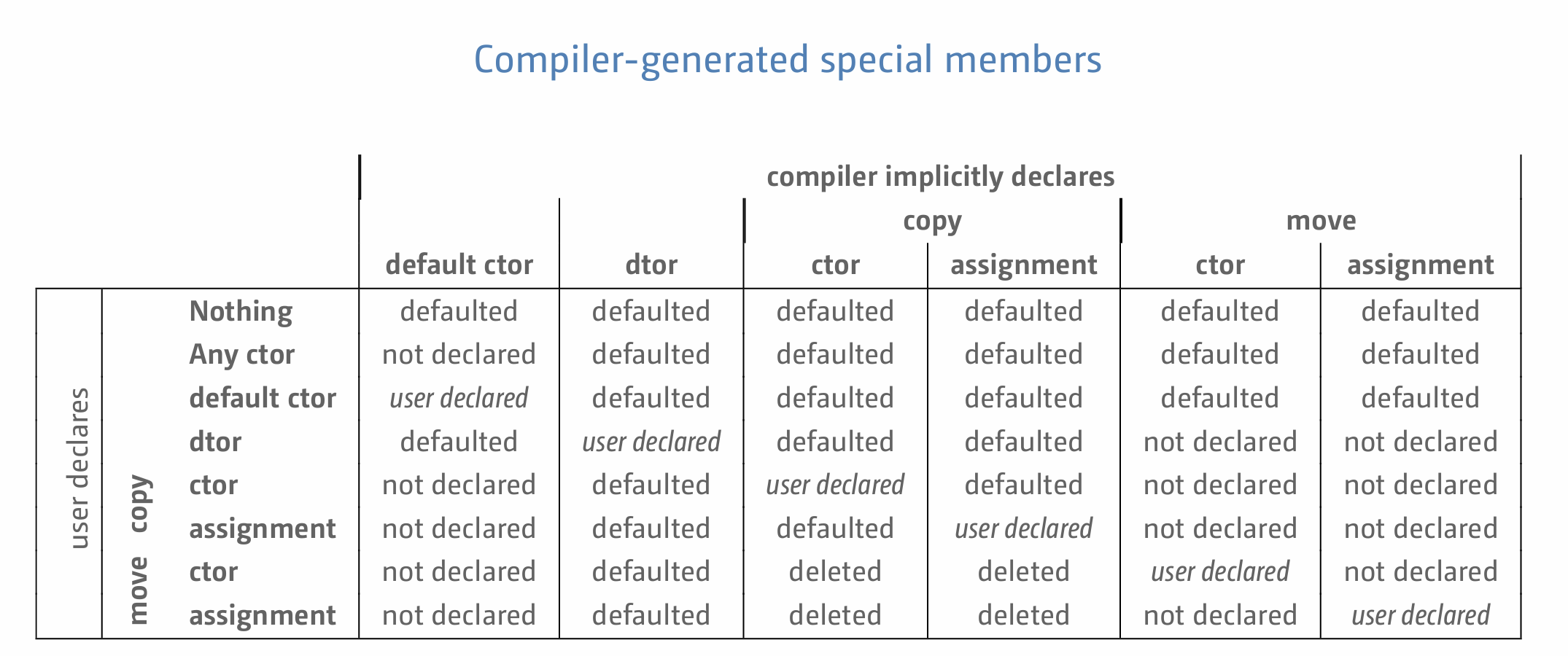
What defaulted, not declared, and deleted mean
These three words are easy to confuse:
- defaulted: the compiler generates it for you
- not declared: the compiler does not even provide it
- deleted: the compiler declares it, but using it is an error
That last case is important.
A deleted function still participates in overload resolution. It just cannot be called.
Declaring constructors affects the default constructor
If we declare any constructor, then the compiler no longer implicitly declares the default constructor.
This is the usual rule people already know: once we write a constructor, the compiler stops giving us the no-argument constructor for free.
Declaring destructor or copy operations kills implicit move
The more important part for move semantics is this: if we declare any of these ourselves:
- destructor
- copy constructor
- copy assignment operator
then the move constructor and move assignment operator are no longer implicitly declared.
This is because the compiler assumes that if we are doing manual resource management, then we probably want to control copying and moving ourselves as well, so it does not give us move support automatically.
Declaring move operations kills implicit copy
If we declare a move constructor or move assignment operator, the compiler treats the type as having an explicit move-aware design, and often effectively a move-only direction unless we also declare copy ourselves.
So the compiler does not silently generate copy operations anymore. Instead, the implicit copy constructor and copy assignment operator become deleted.
This also prevents an rvalue from quietly falling back to copy construction when move exists.
So if we want both move and copy, we must declare both explicitly.
Ref-qualifiers
Move semantics can also be used on member functions.
Consider this append function:
1
2
3
4
5
6
7
8
9
10
11
12
13
14
15
16
17
18
19
20
class string {
    size_t mLen{};
    std::unique_ptr<char[]> mData{};

    void Concat(const char* s);

public:
    string(const char* data);
    string(const string& rhs);
    string& operator=(const string& rhs);
    string(string&& rhs);
    string& operator=(string&& rhs);

    char* c_str() const { return mData.get(); }

    string& append(const char* s) {
        Concat(s);
        return *this;
    }
};
This works fine for normal objects:
1
2
3
string s{"Hello"};
s.append(", world!");
std::cout << s.c_str();
But it also allows this:
1
string s2 = string{"Hello"}.append(", world!");
Here, append() is called on a temporary. Returning string& still works, but it makes the result an lvalue, which means we cannot trigger the move constructor anymore.
Ref-qualifiers fix that:
1
2
3
4
5
6
7
8
9
10
11
12
13
14
15
16
17
18
19
20
21
22
23
24
25
class string {
    size_t mLen{};
    std::unique_ptr<char[]> mData{};

    void Concat(const char* s);

public:
    string(const char* data);
    string(const string& rhs);
    string& operator=(const string& rhs);
    string(string&& rhs);
    string& operator=(string&& rhs);

    char* c_str() const { return mData.get(); }

    string& append(const char* s) & {     // add & here, so this is only for lvalues
        Concat(s);
        return *this;
    }

    string&& append(const char* s) && {   // add && here, so this is only for rvalues
        Concat(s);
        return std::move(*this);
    }
};
Now we have two versions:
append(...) &is called when*thisis an lvalueappend(...) &&is called when*thisis an rvalue
So if append() is called on a normal object, we return string&. If it is called on a temporary, we return string&& and keep the move path available.